Article Summary
When buyers search for an Industrial/Sectional door, they are rarely looking for a door panel alone. They are trying to solve a chain of practical problems at once: energy loss, slow forklift movement, repeated maintenance, safety concerns, poor sealing, noise, and an entrance that simply does not fit the pace of modern logistics or production. In my experience, the best solution is the one that supports daily operations without creating new problems later.
This article explains how to evaluate an Industrial/Sectional door from a real-use perspective, what features matter most in warehouses and industrial buildings, and how the right design can improve efficiency, cleanliness, safety, and long-term cost control. I also introduce how Everbesten Industrial Limited Co., Ltd. approaches these needs with practical product thinking rather than empty claims.
Table of Contents
Outline
In many cases, buyers only realize issues after the door has already been installed and put into daily use. This is because the initial selection often focuses too much on dimensions and pricing, while overlooking how the door will actually perform in real working conditions.
Industrial environments are not static. Doors are opened and closed repeatedly throughout the day, and even small mismatches quickly turn into operational inefficiencies.
At the early stage, a door may appear to meet all basic requirements. However, once it becomes part of daily operations, hidden problems begin to surface.
In high-traffic environments, such as logistics centers or warehouses, the door must operate in sync with continuous forklift movement.
If the opening speed is too slow or inconsistent, forklifts begin to queue, and operators are forced to wait.
What seems like a minor delay per cycle can accumulate into significant time loss across a full working shift.
Over time, this directly impacts efficiency and increases operational pressure.
Sealing performance is often underestimated during purchasing, but it becomes highly visible during use.
Poor sealing allows external elements to enter the facility, including dust, wind, and humidity.
This not only affects working conditions but may also influence product quality, especially in storage or production environments.
For facilities that require environmental control, this becomes a continuous problem rather than a one-time issue.
Some doors are selected based on cost rather than usage intensity.
When installed in high-frequency environments, these doors experience faster wear and tear.
Components degrade more quickly, maintenance becomes more frequent, and unexpected failures begin to occur.
Instead of saving cost, this often leads to higher long-term expenses and operational interruptions.
An industrial door is not just a structural component—it is a transition point between two working environments.
Every movement of goods, forklifts, or personnel passes through this point. If the door does not match the operational rhythm, it becomes a bottleneck rather than a solution.
A more effective approach is to evaluate the door together with:
This ensures the selected solution supports real operations, not just installation requirements.
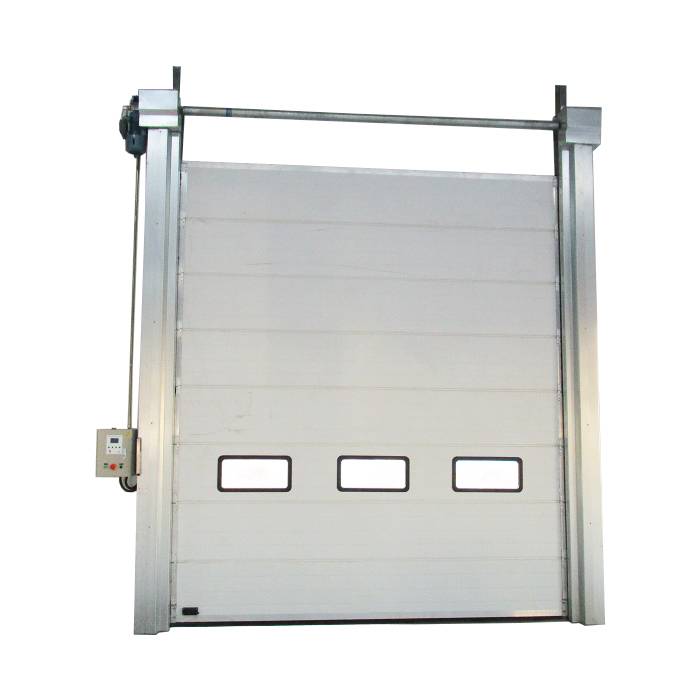
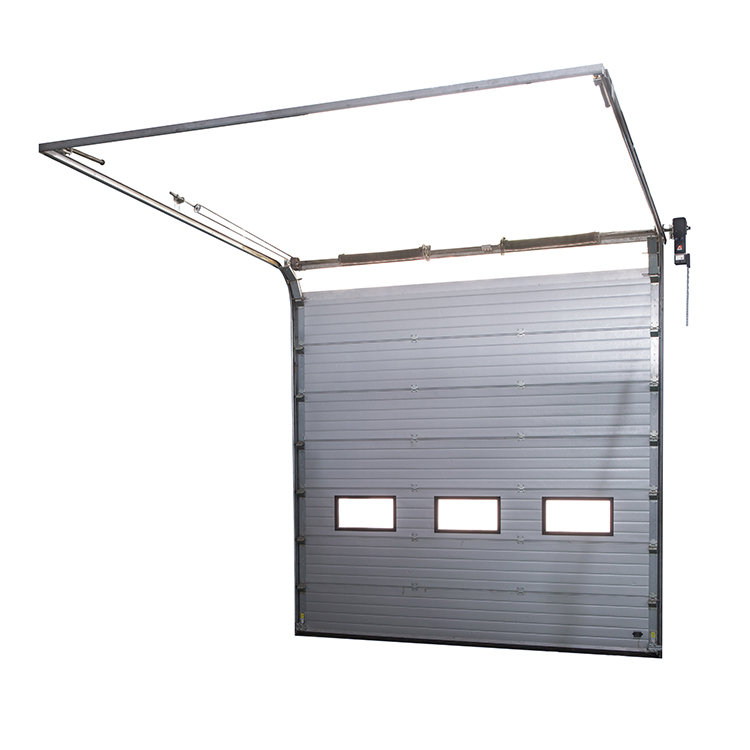
An Industrial/Sectional door is designed to open vertically and move upward along tracks, allowing the door leaf to rest efficiently overhead instead of swinging outward or occupying unnecessary floor area. This matters a great deal in industrial spaces where clearance, traffic flow, and internal planning need to stay flexible.
What makes this type of door attractive is not only the opening method, but the combination of structure, insulation, safety components, and space-saving logic. For facilities where trucks, forklifts, and staff move continuously, that design creates a smoother and more controlled entrance point.
| Comparison Point | Industrial/Sectional Door | Common Basic Door Option |
|---|---|---|
| Opening Direction | Vertical lift with overhead track guidance | Often swings outward or requires larger side space |
| Space Efficiency | Keeps floor and entrance area clear | May reduce usable working space |
| Insulation Potential | Better suited for insulated panel construction | Often less effective in thermal control |
| Suitability for High-Frequency Use | More appropriate for repeated industrial operation | May wear faster under heavy traffic |
| Seal and Weather Performance | Usually better around edges and panel joints | Can be weaker against dust, drafts, and rain |
For buyers who need clean movement, better control, and a more professional façade, an Industrial/Sectional door is usually a far more balanced choice than a basic entry system selected only for short-term savings.
A door becomes part of workflow the moment people and vehicles begin moving through it all day. If opening and closing are slow, visibility is poor, or the path is awkward, operations lose rhythm. If the door performs well, the opposite happens: internal flow becomes more predictable and less stressful.
In practical terms, the right Industrial/Sectional door can support operations in several ways:
I think this is where many buyers change their perspective. They stop asking, “How much is the door?” and start asking, “What is the door costing me every day if it is wrong?” That shift leads to better decisions.
Practical Buying Insight
If your site handles frequent loading, temperature control, or fast internal vehicle movement, the door should be selected as an operational tool, not merely as a construction item.
Buyers usually face too many vague promises and not enough useful detail. To make a good decision, I prefer to narrow the evaluation to the features that affect daily performance most directly.
| Feature | Why It Matters | What Buyers Should Check |
|---|---|---|
| Panel Strength | Supports durability under repeated use | Material quality, panel build, resistance to deformation |
| Thermal Insulation | Helps reduce energy loss and improve comfort | Panel construction, sealing structure, site conditions |
| Sealing Performance | Keeps out dust, wind, moisture, and noise | Edge seals, bottom seal, fit around the frame |
| Safety System | Reduces risk to staff and equipment | Balance system, anti-drop considerations, operating control |
| Track and Lift Design | Determines whether the door matches building space | Headroom, side room, installation condition |
| Ease of Maintenance | Affects lifecycle cost and downtime | Service accessibility, replacement parts, technical support |
A strong supplier should help match these features to the actual site instead of pushing a single standard answer. That is one reason buyers pay attention to companies like Everbesten Industrial Limited Co., Ltd., because product suitability matters as much as product availability.
Industrial sectional doors are designed with real usage scenarios in mind. Rather than simply providing access, they offer a balanced combination of space efficiency, structural stability, and environmental control.
One of the most practical advantages is the vertical lifting design, which fundamentally changes how the entrance area functions.
Because the door opens upward instead of outward, the area around the entrance remains unobstructed.
This allows forklifts to approach more directly and reduces unnecessary maneuvering.
In high-traffic environments, even small improvements in movement efficiency can have a noticeable impact over time.
With no obstruction near the doorway, facilities gain more flexibility in how space is organized.
Goods can be stored closer to the entrance, and equipment can be positioned more efficiently.
This reduces movement distance and helps streamline workflow, especially in space-constrained environments.
The door panel is a key component that determines both environmental performance and structural reliability.
Insulated panel construction helps reduce heat transfer between indoor and outdoor environments.
This is particularly important in applications such as cold storage, temperature-sensitive logistics, or facilities aiming to improve energy efficiency.
Even moderate insulation improvements can result in long-term cost savings.
A well-designed panel structure is capable of withstanding repeated opening cycles without deformation.
This ensures that the door maintains alignment and sealing performance over time, reducing the need for adjustments or repairs.
The track-guided system allows the door to move in a controlled and predictable manner.
Instead of abrupt or uneven motion, the door operates smoothly throughout each cycle.
This stability becomes especially important in high-frequency environments, where reliability directly impacts operational continuity.
In industrial environments, efficiency is not determined by a single factor, but by how well different elements work together. The entrance plays a surprisingly important role in this system.
During busy periods, even small delays can quickly accumulate.
A door that opens and closes consistently helps maintain flow and prevents unnecessary waiting, improving overall efficiency.
A smoother entrance reduces bottlenecks and keeps traffic organized.
This not only improves efficiency but also enhances safety, especially in areas with frequent forklift movement.
Effective sealing prevents dust and external air from entering.
This helps maintain a cleaner working environment and reduces contamination risks in sensitive areas.
Improved temperature stabilityBy minimizing air exchange, the door helps maintain a stable indoor temperature.
This supports energy efficiency and improves comfort for both workers and stored goods.
A reliable door contributes to a more stable operation.
Instead of dealing with frequent issues or breakdowns, facilities can maintain a steady workflow.
This reduces downtime and allows teams to focus on productive tasks rather than reactive maintenance.
A cheap door can become expensive very quickly if it leaks air, causes delays, needs repeated repair, or fails to match the building layout. In contrast, a properly matched Industrial/Sectional door tends to create value quietly over time. It reduces friction rather than drawing attention to itself.
Long-term value usually appears in these areas:
For serious projects, the goal is not to buy the least expensive door on paper. The goal is to buy the door that remains dependable after months and years of real use. That is a very different standard, and it is the one that matters.
Can an Industrial/Sectional door help save interior space?
Yes. Because it opens vertically and follows an overhead track path, it typically leaves the entrance zone and surrounding floor area more usable than many conventional door forms.
Is an Industrial/Sectional door suitable for warehouses with frequent traffic?
In many cases, yes. It is especially suitable for facilities where repeated opening cycles, controlled access, and efficient movement are important.
Why is sealing performance so important?
Good sealing helps reduce dust, drafts, moisture intrusion, and temperature instability. It also contributes to a cleaner and more controlled indoor environment.
Should buyers focus on price first?
Price matters, but it should not be the first or only filter. A better approach is to compare the full operating value of the door, including durability, maintenance, sealing, and suitability for the site.
What should I prepare before asking for a quotation?
Prepare opening dimensions, application photos if possible, usage frequency, environmental conditions, and any special requirements related to insulation, safety, or installation space.
The right Industrial/Sectional door does not just close an opening. It helps a facility work better. It supports movement, reduces waste, improves control, and creates a more dependable operating environment. For warehouses, industrial workshops, and logistics sites, that kind of practical value is exactly what a modern entrance system should deliver.
If you are evaluating door solutions for a new project or planning to upgrade an existing site, Everbesten Industrial Limited Co., Ltd. is worth considering as a partner that understands how industrial access needs to perform in the real world. When you are ready to discuss dimensions, application scenarios, or solution matching in detail, contact us to explore a door system that fits your operation instead of forcing your operation to adapt to the wrong door.